
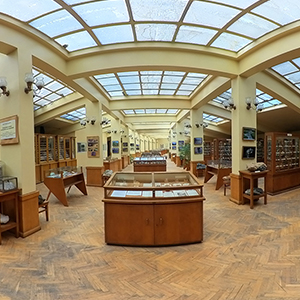
The Museum of Mineralogy, Petrology and Mineral Resources is the oldest museum of rocks and minerals in Bulgaria. Its history began in 1892, when Dr. Bone Baev's students from the First Men's High School donated a collection of 460 mineral and rock specimens to the Higher School, recorded in the inventory book on 02.01.1882. The museum owns numerous collections purchased from European trading companies in the late 19th and early 20th centuries. Among these collections are several collections of minerals and rocks acquired from the German trading firm Kranz during the period 1894-1909. They are distinguished by their great species diversity and some of them are representative of type localities from all over the world.
The main purpose of exhibiting these specimens is to educate students from the Department of Mineralogy, Petrology, and Mineral Resources. The arrangement of the showcases is tailored to the educational programs. Simultaneously, the museum showcases specimens with high museum and collector's value. The following are considered valuable for the museum:
- Holotypes of minerals discovered in Bulgaria;
- Type specimens from Bulgarian and foreign already depleted deposits;
- Specimens from the personal collections of renowned geologists;
- Specimens that have been researched and described in books, textbooks, and publications by professors and students from the department.
Съдържание на колекцията
- АКТИНОЛИТ, АЛБИТ
- АКТИНОЛИТ, ТАЛК, ВЕРМИКУЛИТ
- АРАГОНИТ
- БЕРИЛ, АЛБИТ, МУСКОВИТ
- ГАЛЕНИТ СФАЛЕРИТ
- ДОЛОМИТ
- ЕПИДОТ, КВАРЦ
- ЗЛАТО
- Календар "Минерали 2024"
- КАЛЦИТ (седловидни агрегати)
- КВАРЦ
- КВАРЦ (АМЕСТИСТ), ХАЛЦЕДОН
- КВАРЦ (МОРИОН)
- КВАРЦ, БАРИТ
- КВАРЦ, ХАЛЦЕДОН (АХАТ - УРУГВАЙСКИ ТИП)
- КВАРЦ, ХАЛЦЕДОН (ГЕОДА)
- МАЛАХИТ
- МЕД
- Музей по минералогия, петрология и полезни изкопаеми - "Регионална колекция"
- Музей по минералогия, петрология и полезни изкопаеми - изложба "Минерали от Антарктика"
- Музей по минералогия, петрология и полезни изкопаеми - колекция "Петрология"
- Музей по минералогия, петрология и полезни изкопаеми - обща обиколка
- ОПАЛ (ВОСЪЧЕН)
- ОПАЛ ПО ДЪРВО
- ОРТОКЛАЗ
- ПИРИТ
- ПИРИТ
- ПИРИТ
- ПИРИТ
- ПИРИТ ПО ПИРОТИН
- ПИРОМОРФИТ
- РОДОХРОЗИТ, ХАЛЦЕДОН, ХАЛКОПИРИТ, ГАЛЕНИТ, СФАЛЕРИТ
- САМОРОДНА МЕД, МАГНЕТИТ
- САМОРОДНА СЯРА
- СРЕБРО
- СРЕБРО, АМАЛГАМА
- СРЕБРО, КАЛЦИТ
- СТИЛБИТ, ХЕЙЛАНДИТ
- СФАЛЕРИТ
- СФАЛЕРИТ
- СЯРА
- ХАЛКОПИРИТ, ПИРИТ, КОВЕЛИН, ГИПС
- ХАЛЦЕДОН (АХАТ - УРУГВАЙСКИ ТИП)
- ХАЛЦЕДОН (АХАТ)
- ХАЛЦЕДОН (САГЕНИТОВ ТИП)
- ХАЛЦЕДОН, ХЛОРИТ (МЪХОВ АХАТ)
- ЯСПИС


